
Last updated November 18, 2026
 AC repair
 Furnace & heating
 Heat pumps
 Ductless mini splits
 Carrier
 Trane
 Goodman
Seasonal tune-up and full diagnostic on your Carrier, Trane, or Goodman system - readings shown to you before any repair is proposed
Diagnosis first, numbers second - you approve the repair price before a single part goes in.
Get your free estimateAC Repair Troubleshooting: Common Problems and How to Fix Them
A dead capacitor costs $150 to $300 to replace professionally. A misdiagnosed “dead compressor” costs North Las Vegas homeowners $1,200 to $3,500 in unnecessary replacements every summer. That gap is the whole reason this guide exists. Most troubleshooting advice starts and ends with “check the thermostat,” but in this desert market the failures we see most are electrical and airflow problems that look like catastrophic breakdowns and aren’t. Below, you’ll learn to name what’s wrong before you call anyone: which side of the system is failing, what each failure sounds and smells like, how to read your brand’s error codes, and which ten-minute checks are safe to run yourself. North Las Vegas heat makes all of this time-sensitive, and naming the problem accurately is what turns a two-visit guess into a one-visit fix.
Quick Answer
Most AC failures in North Las Vegas fall into three groups: electrical (capacitor, disconnect box, contactor), refrigerant-side (low charge, frozen coil), and airflow (clogged filter, blocked return). You can safely check the thermostat, filter, and outdoor disconnect yourself in under ten minutes. Anything involving the capacitor, compressor, or refrigerant lines needs a trained technician, because those components hold a charge or run at high voltage even after the system is switched off.
Styles & brands we work with
- AC repair
- Furnace & heating
- Heat pumps
- Ductless mini splits
- Carrier
- Trane
- Goodman
Table of Contents
- The Symptom-to-Cause Matrix: Electrical vs. Refrigerant vs. Airflow
- The 10-Minute Safe Check a Homeowner Can Run
- Why the Disconnect Box Fools Almost Everyone
- The Capacitor: The $200 Part That Gets Mistaken for a Dead Compressor
- Reading Your Thermostat’s Error Codes by Brand
- Short-Cycling: The Diagnostic Emergency in Desert Heat
- What to Have Ready Before You Call
- When to Call a Professional
The Symptom-to-Cause Matrix: Electrical vs. Refrigerant vs. Airflow
The fastest way to point a technician in the right direction is to sort the failure into one of three buckets. Each bucket has its own signature, and once you hear, smell, or feel which one you’re in, the diagnostic conversation gets much shorter.
- Electrical side. The system is silent or shuts down completely. No hum from the outdoor unit, or a brief hum that stops. The thermostat may be blank or reading a fault code. Nothing smells hot inside; the breaker may or may not have tripped. In our experience across North Las Vegas new builds, this bucket is where most “the AC is dead” calls actually land, and it’s almost never the compressor.
- Refrigerant side. The system runs but doesn’t cool. You may see frost or ice on the copper lines near the outdoor unit or on the indoor coil, water pooling in the drain pan, or a musty smell if the coil has been frozen a while. The indoor blower keeps running, the outdoor fan spins, but the air coming from the vents feels only slightly cooler than room temperature.
- Airflow side. The system runs, the outdoor unit cycles normally, but the house stays warm and the vents feel weak. You may hear whistling at the return grille or feel that some rooms never cool. A filter that hasn’t been changed since spring, or a return blocked by furniture, is the usual culprit, and it can mimic a refrigerant problem within a day or two of Las Vegas Valley dust season.
Once you know your bucket, the rest of this guide narrows to the specific component. If the failure turns out to be major and repair no longer makes sense, our team handles AC Installation in North Las Vegas with a written fixed price before any work begins.
The 10-Minute Safe Check a Homeowner Can Run
You can rule out several of the most common, least expensive causes without opening a panel or touching a wire. Do these in order, and write down what you find, because each answer shortens your call.
- Check the thermostat. Make sure it’s set to COOL, the fan is on AUTO, and the setpoint is at least 3 degrees below room temperature. If the display is blank, check the batteries or the breaker feeding the air handler before assuming the system is dead.
- Replace or inspect the filter. A clogged filter is the single most common cause of weak airflow and frozen coils in this climate. Pull it, hold it to a light, and if you can’t see through it, replace it.
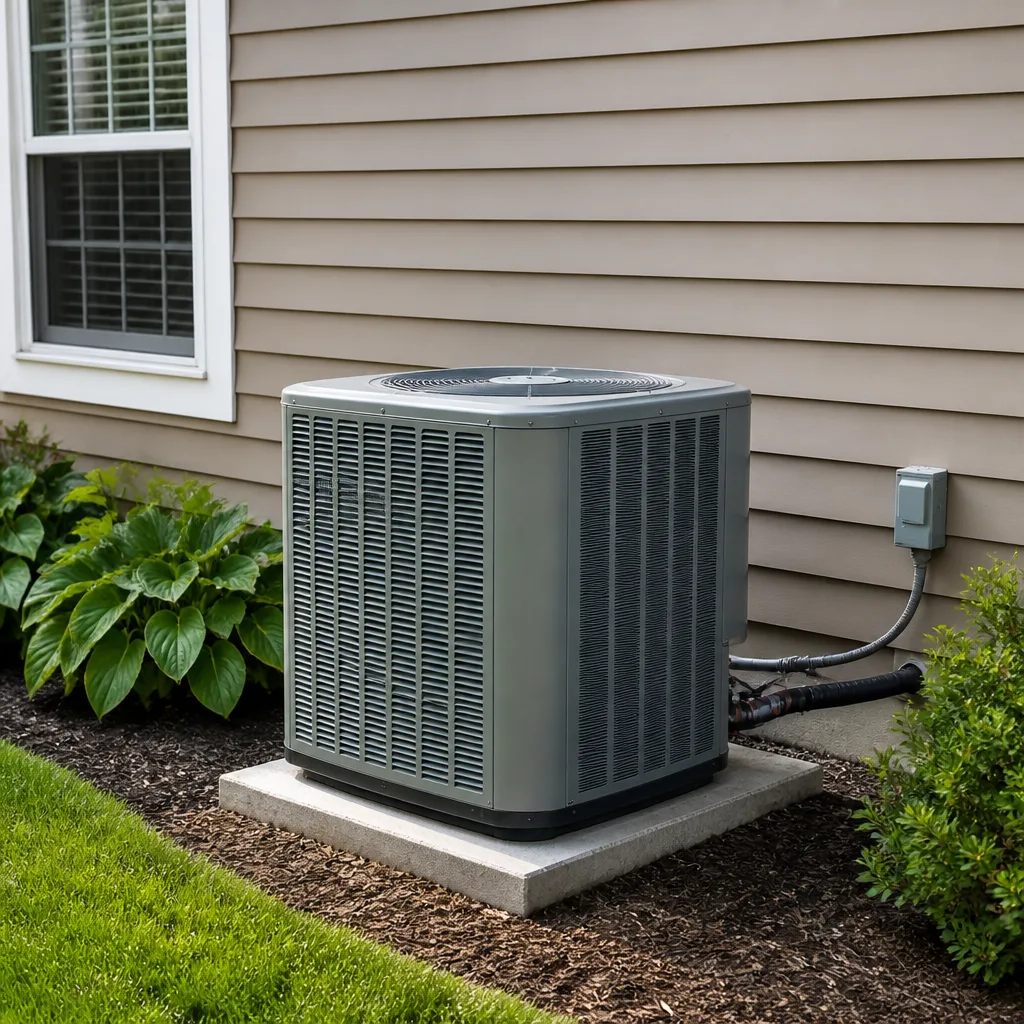
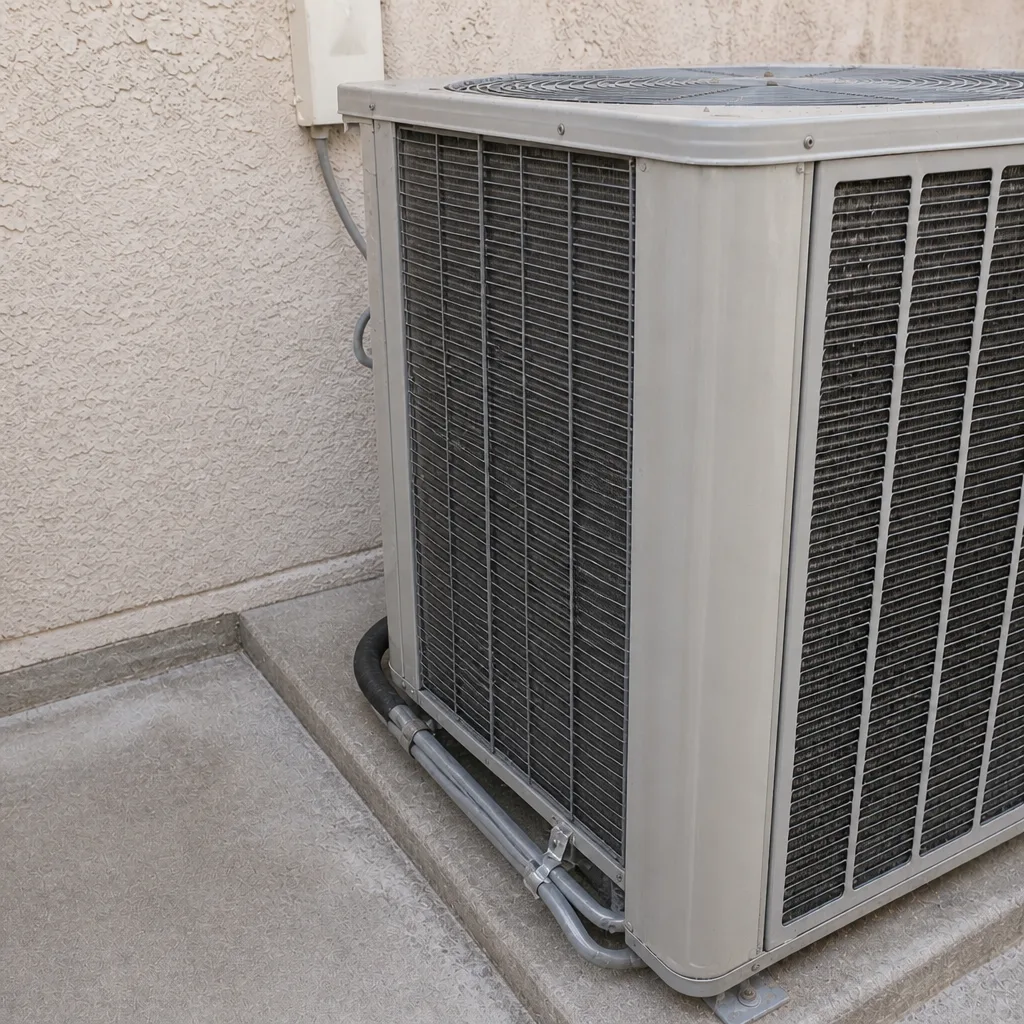
- Look at the outdoor disconnect box. This is the small gray box mounted on the wall near the condenser. It usually has a pull-out handle. With the system off at the thermostat, check that the handle is fully seated. A partially pulled handle looks fine from a distance and cuts power completely.
- Check the breaker. Find the double-pole breaker labeled for the AC in your panel and confirm it hasn’t tripped. If it has, reset it once. If it trips again, stop and call a technician.
- Listen at the outdoor unit. With the thermostat calling for cool, stand near the condenser for 30 seconds. Note whether the fan spins, whether you hear a hum, and whether the hum stops after a few seconds. Those three answers tell a technician a lot.
- Clear the outdoor unit. Make sure nothing is stacked against the condenser and that the top is free of leaves and dust. In North Las Vegas, a condenser surrounded by stored boxes or blocked by a fence panel runs hotter and works harder.
- Note the indoor symptoms. Any ice on the lines, water in the pan, or unusual smells inside? Photograph what you see.
That’s the entire safe list. Everything past this point involves a component under load or a sealed refrigerant circuit, and we’d rather you not go there. Our technicians have up to 22 years of experience with these systems, and the checks above are exactly what they’d ask you to do on the phone.
Why the Disconnect Box Fools Almost Everyone
The disconnect box is a small, unglamorous part of your AC, and it causes a surprising share of total-shutdown calls. It sits on the exterior wall near the condenser and holds a pull-out handle or fuse block that lets a technician cut power to the outdoor unit for service. What happens in real life: someone pulls the handle during a storm or a landscaping project, seats it back only partway, and the unit goes silent. From inside the house, it looks identical to a dead compressor.
Here’s the tell. If your thermostat is working, the indoor blower is running, and the outdoor unit makes no sound and no heat at all, and the condenser fan isn’t spinning, your first move is to look at that handle. If it’s fully seated, you’ve ruled out the cheapest possible cause in 30 seconds.
What you shouldn’t do is pull the handle while the system is running or open the box to inspect the wiring. The disconnect box connects to high-voltage lines that stay live even when the system is off. In North Las Vegas, where summer afternoons regularly push the outdoor unit to its thermal limits, a loose connection inside the box can also arc and overheat. That’s a technician job, and a quick one. Our technicians keep a written price ready before they touch anything, so if the fix is a disconnect handle and a tightened lug, you’ll know that in dollars before the work starts.
The Capacitor: The $200 Part That Gets Mistaken for a Dead Compressor
The capacitor is a small cylindrical component that gives the compressor and outdoor fan motor the jolt they need to start and keeps them running steadily. When it weakens or fails, the system often does one of two things: it hums and shuts off within a few seconds, or it tries to start and trips the breaker. Both of those symptoms look like a dead compressor to a homeowner, and both are usually a $150 to $300 capacitor replacement.
A genuinely failed compressor is a different animal. It typically shows up after years of service, often alongside a history of hard starts, refrigerant problems, or overheating during a heat wave. The point is that the two failures are not visually distinguishable from the outside, and the cost difference is enormous. A capacitor job is a service call. A compressor replacement can run $1,200 to $3,500, and a misdiagnosis means paying for the bigger repair when a smaller one would have worked.
For our part, this is where we lean hardest on our diagnostic process. A technician who checks the capacitor first, before quoting anything at compressor scale, is doing the job right. A technician who quotes a compressor over the phone, without testing the capacitor and the start components, has skipped a step. When you call, ask whether the capacitor has been tested. If the system is running on borrowed time, our team can walk you through repair versus replacement honestly, and we’re qualified to service equipment from nine leading brands, including Goodman and Rheem, which are common in newer North Las Vegas subdivisions.
Please don’t open the outdoor unit and probe the capacitor yourself. Capacitors can hold a dangerous charge after power is cut, and the terminals are easy to contact. This is exactly the kind of safety call we’d rather you hand to a trained technician.
Reading Your Thermostat’s Error Codes by Brand
If your thermostat displays a fault code, that code is a shortcut to the problem. The five brands we see most often in North Las Vegas homes each use a slightly different code language. Before you call, jot down the exact code and the thermostat model, which is printed on the back of the unit or in your manual.
- Carrier and Bryant. These systems often display two-letter codes. “E1” or “E2” is typically a communication or sensor fault; “E4” usually points to a high-limit or pressure issue. A flashing LED on the indoor board can add detail the thermostat screen won’t show.
- Lennox. Lennox controls often use numeric codes, and a short cycle with a specific code can indicate a pressure switch or a sensor reading outside range. If the screen shows a code plus a flashing light, the light pattern is what a technician will use.
- Trane. Trane systems often report a solid or flashing status light with a code. A faster flash pattern usually indicates a more serious fault and is worth flagging on the call.
- Rheem. Rheem controls typically use a flashing LED pattern on the furnace board or the air handler, and the code appears as a count. Count the flashes between pauses and write down the sequence.
- Goodman. Goodman systems use a similar flashing pattern. A short cycle plus a code is a strong indicator that the capacitor or a start component is failing, which matches what we see in many North Las Vegas builds.
Don’t try to clear the code by powering the system down and back up before you’ve written it down. Some codes clear on reset, and the information is gone. Photograph the screen if you can. A code in hand is often the difference between a 20-minute diagnosis and a longer hunt.
Short-Cycling: The Diagnostic Emergency in Desert Heat
Short-cycling means the unit turns on and off every few minutes. In a mild climate, that’s an annoyance. In North Las Vegas, it’s a diagnostic emergency, because the unit never runs long enough to pull the moisture out of the air and it’s also wearing out the compressor with every start. Each on-and-off cycle drives a fresh inrush of current through the capacitor and the windings, and in summer heat, a capacitor that’s already weak will fail under that load within days.
Short-cycling has a short list of usual causes:
- An oversized or undersized system. If the unit has short-cycled since the house was new, the load calculation may have been wrong at install.
- A dirty filter or blocked return. Restricted airflow makes the coil ice up, then thaw, then ice again.
- A failing thermostat or a thermostat placed in a hot spot. A thermostat near a west-facing window or a heat source will read warm, call for cool, and turn off as soon as the room’s cool air reaches it.
- Low refrigerant. A low charge can force the system into a pressure shutdown on a repeating schedule.
- An overheating compressor. The system trips its internal protector, cools, then tries again.
None of these are “wait and see” situations in triple-digit heat. If your North Las Vegas home is short-cycling, turn the system off at the thermostat to protect the compressor, then call. Our team takes after-hours calls live, 24 hours a day, seven days a week, including nights and weekends, and every repair is backed by our 365-Day Done Right Promise. Free estimates and a written price before any work starts are standard on every call.
What to Have Ready Before You Call
The more accurate your description when you call, the higher the chance the first visit fixes it. When you reach us, have these details ready:
- The equipment brand and model. The outdoor unit’s nameplate has a model number, and the furnace or air handler has one too. Read off all three: brand, model, and serial.
- Your thermostat code, photographed. If a code displayed, include it, plus the thermostat brand and model.
- A one-line symptom summary. “Silent outdoor unit, indoor blower running, no ice, filter changed last week” is worth a lot. So is “runs and cools weakly, lines frosted.” Be specific about what you heard, smelled, or felt.
- Breaker and disconnect status. Tell the person on the phone whether you checked the breaker and whether the disconnect handle is fully seated.
- Any recent work. If a contractor touched the system, a filter was changed, or a landscape crew worked near the condenser, mention it.
- Household details. Note kids, pets, and nap schedules so the technician schedules around them. We put down shoe covers and drop cloths on every visit and send a photo of the clean-up before the crew leaves.
If the issue is cooling or heating rather than a specific component, our team also handles Furnace Repair in North Las Vegas and can look at the whole system while we’re there, saving a second visit.
When to Call a Professional
Some problems have a safe homeowner answer and some don’t. Call a professional, without going further yourself, when any of the following is true: the breaker trips a second time, you see ice on the indoor coil or the copper lines, the disconnect box is warm to the touch or smells burnt, the outdoor unit hums without starting, short-cycling has begun, or your thermostat shows a fault code that won’t clear. All of those put you past the safe-check line, and a few of them are genuinely dangerous. If you simply have a house full of kids and animals and no cooling, don’t wait to figure it out. Meadowsweet Heating & Air North Las Vegas offers free estimates in North Las Vegas, and a live person answers every call, 24 hours a day. Call (844) 320-2997 and we’ll tell you what the next step looks like before anyone is dispatched.
See the difference
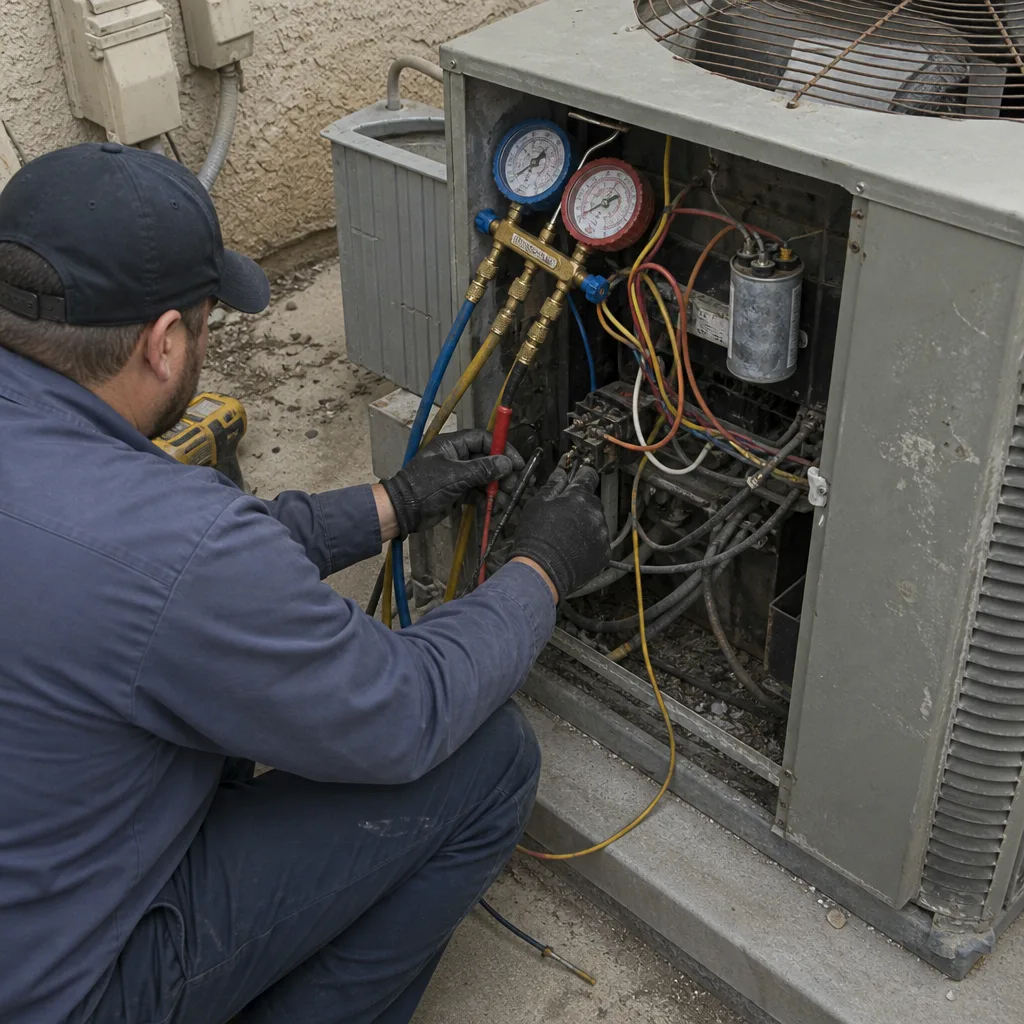 Before
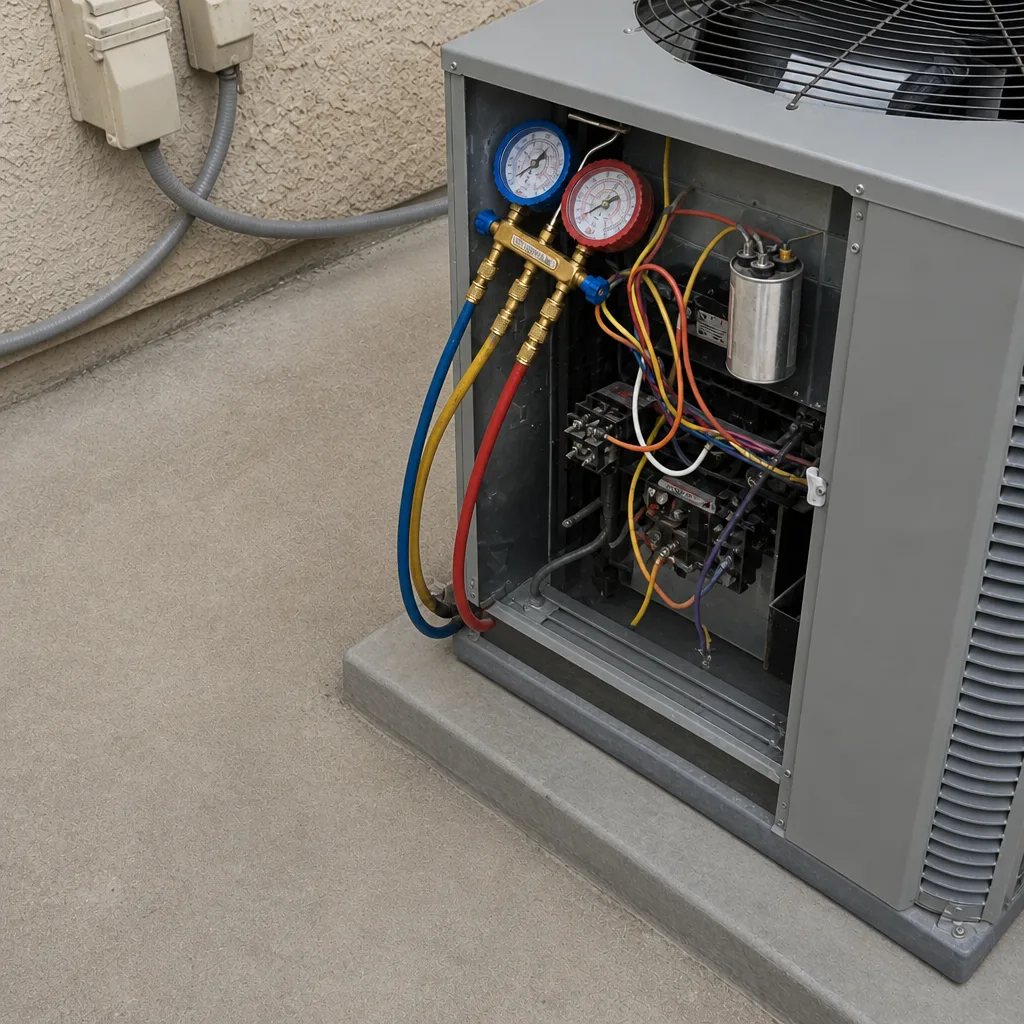 After
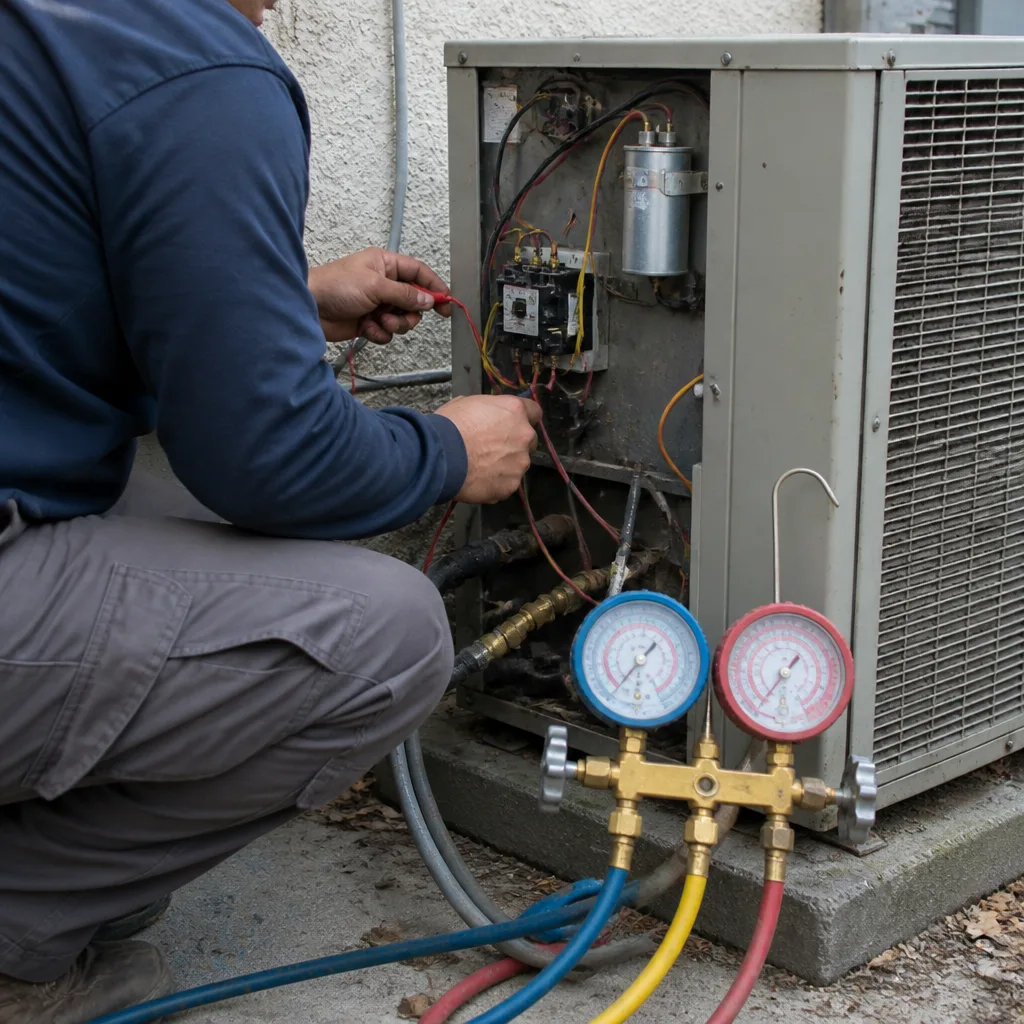 Before
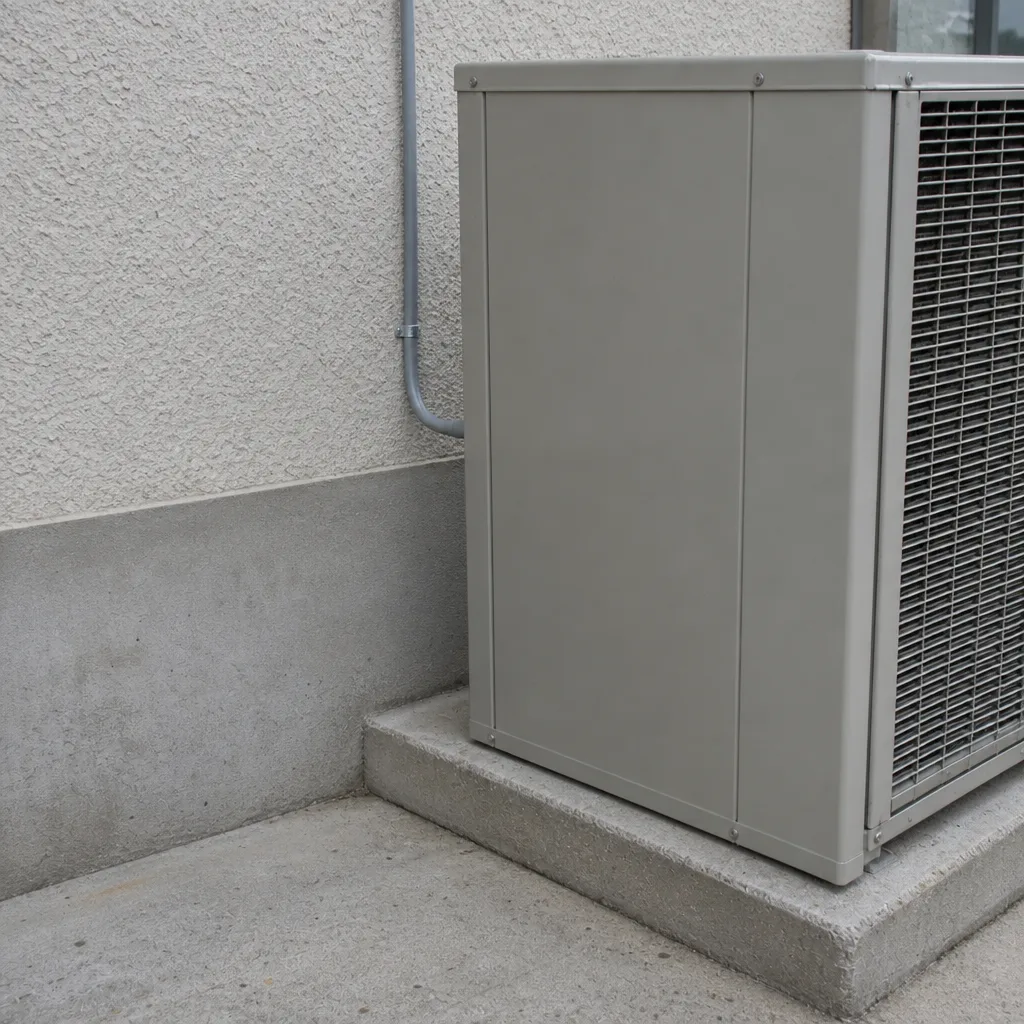 After
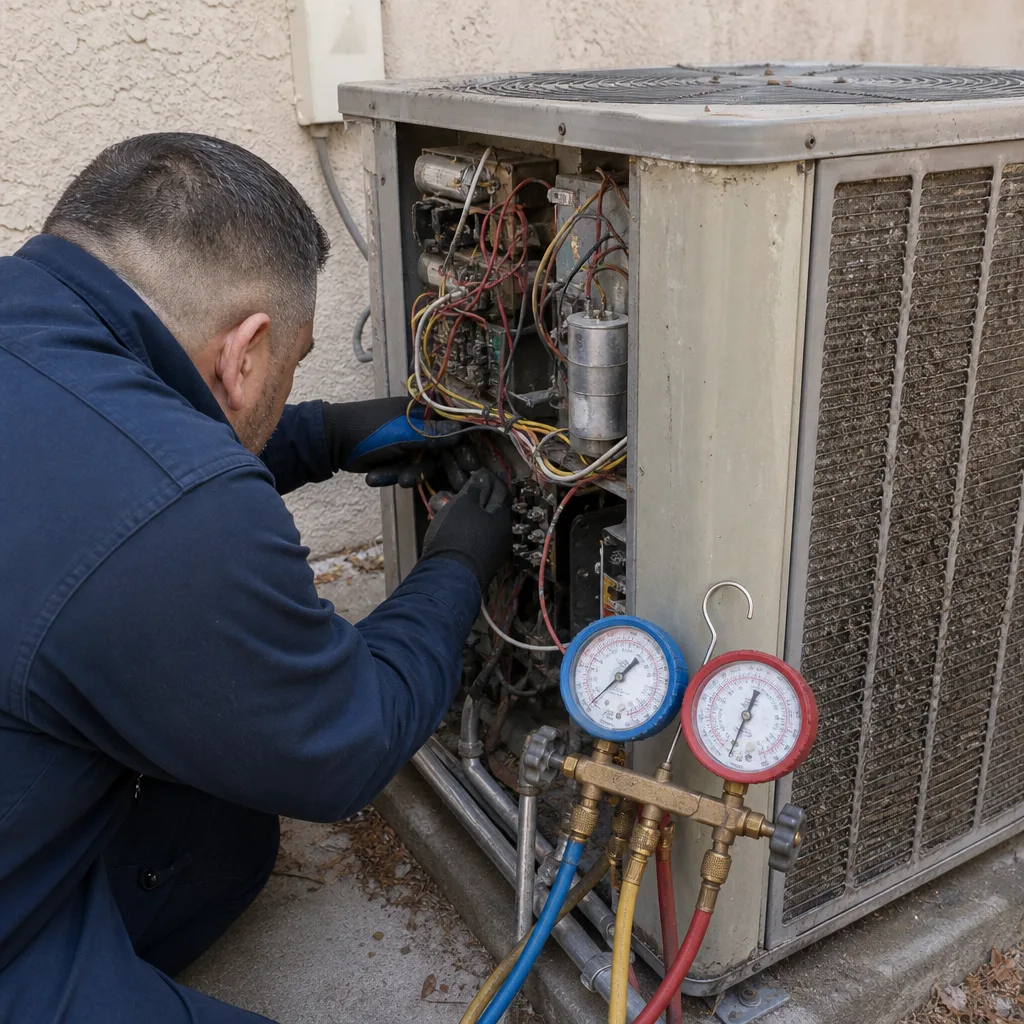 Before
 After
Common Mistakes to Avoid
- Assuming a dead compressor before the capacitor is tested. We see this every summer in North Las Vegas, and it’s the costliest mistake on this list. A $150 to $300 capacitor replacement is almost always worth ruling out before anyone quotes a compressor.
- Ignoring short-cycling through a heat wave. Every on-off cycle stresses the compressor, and in our climate, the damage adds up within days, not months. Treat it as urgent.
- Clearing error codes before writing them down. A reset wipes the code, and the technician loses a shortcut. Photograph the screen first.
- Opening the disconnect box or the outdoor unit. Both contain high-voltage and stored-charge components. A pulled-out handle is a safe check; the inside is not.
- Changing the filter late in the season. In a dusty Las Vegas Valley summer, a filter plugs up faster than in most of the country. Many North Las Vegas homes need a fresh filter every 30 days from June through September.
- Blocking the outdoor unit with fencing or storage. A condenser that can’t shed heat runs longer, cycles more, and fails sooner, especially on a west wall that gets full afternoon sun.
- Running the system with a frozen coil. If there’s ice, switch it off at the thermostat. Running the unit with a frozen coil can damage the compressor, and it wastes energy.
If any of these lead to a real repair, we handle AC Repair in North Las Vegas with a written price before work begins and a 365-Day Done Right Promise on the result. Our technicians have up to 22 years of experience and are background-checked and uniformed, and they follow our C.A.R.E. values: clean up like it’s their own home, ask before moving anything, respect the family’s time and quiet hours, and explain the price before the work.
Frequently Asked Questions
Electrical failures usually produce a total shutdown (silence, no outdoor fan, no hum) or a short hum that stops, while refrigerant-side failures usually run but don’t cool and may show frost or ice on the copper lines. Airflow problems feel like weak vents with everything running normally. When in doubt, run the 10-minute safe check, then describe what you heard and felt to a technician.
No. A humming unit that shuts off after a few seconds is very often a failing capacitor, a start component, or a loose disconnect handle – all far cheaper fixes than a compressor. In our experience, most hum-and-stop calls we see in North Las Vegas end with a $150 to $300 capacitor replacement rather than a major compressor job. Ask that the capacitor be tested before anyone quotes compressor-scale work. Call (844) 320-2997 for a free estimate, and we’ll test before we recommend.
Write the code down exactly, photograph the screen, and note your thermostat’s brand and model before doing anything else. Some codes clear on reset, so the information is worth protecting. Then call and read the code over the phone: on Carrier, Lennox, Trane, Rheem, and Goodman systems, the right code often narrows the problem to one component before the technician even arrives.
Because summer heat leaves no margin. The system runs at the top of its capacity, so a weak capacitor, a plugged filter, or a slightly low refrigerant charge that would be tolerable in a milder climate forces a shutdown within minutes. That’s why we treat short-cycling in North Las Vegas as an emergency, not a “watch and wait” situation.
Most capacitor, contactor, and disconnect repairs run $150 to $300; refrigerant-side diagnostics and repairs typically start higher, and compressor work can run $1,200 to $3,500. Our team provides a written price before any work starts, so you’ll see the number in dollars before anyone picks up a tool. Call (844) 320-2997 for a free estimate, and we’ll walk you through what we expect to find.
In most cases, yes. Calls are answered by a live person 24 hours a day, seven days a week, and we schedule around the family’s day: school pickups, nap times, and pet routines. Call (844) 320-2997 and the person on the line will give you the next available window and, where we can, a same-day visit. If your system is short-cycling or showing a fault code, tell us when you call: cooling failures in this heat are a priority.
The Bottom Line
Most “dead AC” calls in North Las Vegas aren’t dead compressors. They’re capacitors, disconnect handles, clogged filters, or short-cycling systems that never got to run long enough to cool. The ten-minute safe check rules out the cheap causes, the symptom-to-cause matrix points to the right bucket, and your thermostat code shortens the diagnostic conversation. Everything past that belongs to a trained technician, and that’s fine, because the right technician arrives with a written price, tells you what the failure actually is, and stands behind the work. Repair first, replacement only when it makes sense. That’s the whole point of troubleshooting.
Our team at Meadowsweet Heating & Air North Las Vegas home is here to help you sort out what’s wrong, with technicians who have up to 22 years of experience, background checks, and shoe covers and drop cloths on every visit. Call (844) 320-2997 for a free estimate and a written price before any work starts. If your repair is really a replacement, our team handles AC Installation in North Las Vegas with a set install date, fixed price, and the right documentation from start to finish.
Written by the team at Meadowsweet Heating & Air North Las Vegas.